Why I Don’t Use Backing Tracks—and Why That Makes Events More Fun
When you’re planning an event—whether it’s a wedding, party, or corporate celebration—you want the music to do more than just fill the air. You want it to create atmosphere, spark joy, and leave your guests with memories that last.
That’s why the question of backing tracks is more important than you might think.
On the surface, backing tracks can sound appealing. They make a solo performer sound like a full band, and they deliver a polished, “radio-like” sound. But there’s a trade-off: the performer is locked into the track. The spontaneity, interactivity, and freedom that make live music magical are gone.
As a musician with 25+ years of experience, I’ve chosen not to use backing tracks. And here’s why that choice benefits you.
What Backing Tracks Really Are
Backing tracks are pre-recorded accompaniments. Once the performer presses play, the song unfolds the same way every time. The groove, the tempo, the arrangement—it’s all predetermined.
This means the performer is essentially doing live karaoke with their instrument or voice. They’re not shaping the music in real time—they’re fitting themselves into a recording.
For you and your guests, that means less interaction, less flexibility, and less fun.
So ask yourself:
-
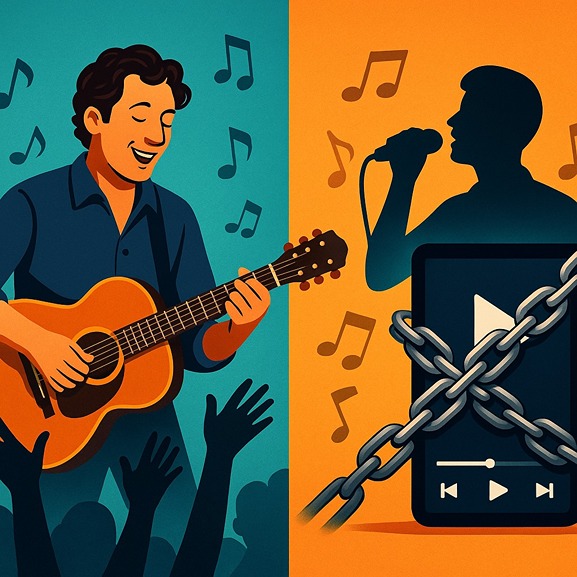
Do you want your event to sound like Spotify with a singer on top?
-
Or do you want something alive, responsive, and unique to your night?
My Jazz Roots & Why They Matter for Your Event
I started out as a jazz musician, and jazz instilled in me values that go far beyond the genre itself. Jazz is about honesty, raw emotion, and authenticity. Every great jazz artist is completely unique—Miles Davis doesn’t sound like John Coltrane, who doesn’t sound like Thelonious Monk. They didn’t try to be polished replicas of someone else; they told the truth through their sound.
That’s the mindset I bring to every performance, no matter the style. When I play your event, it’s not about copying a recording note for note. It’s about bringing something real, something in-the-moment, something that feels alive.
That’s the difference between music that people hear—and music that people feel.
Why Tracks Feel Like Chains
One of the reasons I don’t use tracks is simple: once you press play, you’re chained to it.
You can’t extend the chorus if the dance floor is just catching fire. You can’t slow down if the energy in the room shifts. You can’t invite a guest up to sing without breaking the track.
I don’t want your event to feel chained. I want it to feel free, organic, and responsive.
Because that’s where the fun is.
The Secret Ingredient
The most memorable events I’ve played all had one thing in common: interactivity.
-
Sometimes that means getting guests to sing along.
-
Sometimes it’s stretching out into an extended jam that takes on a life of its own.
-
Sometimes it’s weaving songs into a spontaneous medley that keeps everyone guessing.
-
I’ve even played dance marathons where the music shifted moment by moment to fuel the crowd’s energy.
You can’t do any of this with backing tracks. They don’t bend or adapt—they dictate.
But without tracks, the possibilities are endless. Your guests don’t just watch a show—they become part of it.
Creating “Perfect Moments”
One of the things I’ve developed over decades of performing is what I call presence. It’s not just being in the moment—it’s being slightly ahead of the moment.
When I’m playing, I’m not only responding to what’s happening right now. I’m anticipating what should happen next, and gently guiding the flow so that when the moment arrives, it feels natural and inevitable. Then I’m already preparing the moment after that.
It’s like creating a series of perfect moments, one after the other, throughout your event.
And this can only happen when the music is free to breathe. Backing tracks lock everything in. Live, track-free music allows me to sculpt the evening in real time, giving your event a smooth, magical flow.
Freedom in Action
Improvisation isn’t just about solos—it’s about freedom at every level.
One of the best compliments I ever received came from a saxophonist I was playing with. He said he loved that I could instantly change the direction of my comping based on what he was playing, instead of sticking stubbornly to what I’d planned. That’s improvisation. That’s listening. That’s collaboration.
And it’s not limited to solos:
-
At the song level, we can build, extend, or reshape sections on the fly.
-
At the set level, we can pivot based on the crowd’s mood—slowing things down or keeping the energy high.
-
At the event level, we can adapt the entire evening’s soundtrack so it matches the flow of your celebration.
This doesn’t mean there’s no structure. Jazz—and live music in general—is highly organized. It just means the organization is flexible, responsive, and alive.
The Architecture of Music
Here’s where it gets exciting. Live music isn’t random—it has a natural architecture. I like to think of it as nested arcs:
-
A solo has an arc: it begins simply, builds to a climax, and resolves.
-
A song has a bigger arc: verses, choruses, dynamics rising and falling.
-
A set has an even bigger arc: starting gently, peaking in energy, cooling down.
-
An entire event has the biggest arc: cocktail hour, dinner, dancing, winding down.
Each of these arcs nests inside the larger one, like layers of a story.
When musicians don’t use tracks, we can shape those arcs in real time, adjusting them to fit the energy of your night. With tracks, you lose that flexibility—the arcs are locked in, whether or not they match the moment.
The Invisible Foundation
How can musicians pull this off without everything falling into chaos? The answer is trust.
After 25 years of performing, I’ve developed deep trust in my craft—and in the musicians I hire. Most of the people I work with are jazz-trained, which means they’re masters at listening, adapting, and contributing ideas nonverbally.
We don’t need to script every detail. We trust that our musicianship will guide us, shaping the event both microscopically (moment by moment) and macroscopically (the whole night).
For you, that means you don’t have to worry. You can relax, knowing the music will adapt seamlessly to the flow of your event.
What Guests Actually Remember
Here’s a secret: guests don’t remember perfection.
They don’t walk away saying, “The band never missed a note.” They walk away saying, “That was so much fun!”
They remember singing along, or the moment when the music built and built until the whole room erupted, or how the band seemed to read the crowd’s mind.
That’s what stays with people. And that only happens when the music is alive, not pre-programmed.
What You’re Really Choosing
When you decide whether to hire musicians who use backing tracks or not, you’re really choosing between two experiences:
-
Backing Tracks = Polished, predictable, stiff, and unchanging.
-
Track-Free Live Music = Interactive, adaptive, authentic, and unforgettable.
Here’s what you get with track-free performances:
-
Freedom – the music follows your event, not the other way around.
-
Interactivity – guests become part of the show.
-
Authenticity – everything you hear is created live.
-
Spontaneity – no two nights are ever the same.
-
Presence – perfect moments created in real time.
-
Memories – a soundtrack unique to your celebration.
After decades of playing weddings, parties, and corporate events, I can tell you: the most joyful, most talked-about, most unforgettable events I’ve ever been part of have always been the ones where the music was free to breathe.
Final Thoughts
At the end of the day, you have a choice.
Do you want something that sounds like Spotify—a polished but canned performance that could happen anywhere, for anyone?
Or do you want something that feels like an adventure, shaped by your guests, your energy, and your celebration—something no one will ever experience again?
If it’s the latter, then you want musicians who play live music that’s actually live.
Because that’s how you turn an event into a memory your guests will carry with them forever.
—
If you are planning a wedding, private party, or corporate event and you want to explore your options for musicians to provide live music, book a free music consultation with me or simply write to me on the contact page.
