
What the Movie Pleasantville Teaches Us About the Artist’s Journey
Some films are entertaining. Others are clever. A rare few rise above those categories entirely—they touch something deep, something universal, something about what it means to be human. For me, Pleasantville falls firmly in that last category. I don’t use the word “masterpiece” lightly, but this film earns it.
I often find myself more deeply moved by books or music than by movies. Many films, at least to my eyes, are overproduced or narratively thin—too much spectacle, too little soul. But Pleasantville is a different kind of story: elegant, layered, emotionally alive. It’s a film that doesn’t just entertain; it awakens. And it does so in a way that directly parallels the journey of any artist—especially musicians.
In many ways, Pleasantville isn’t really a movie about a fictional 1950s sitcom world. It’s a film about what happens when creativity, uncertainty, emotion, and imperfection enter a previously rigid system. It’s about what happens when art is allowed to breathe. As I reflect on the film through the lens of my own life as a musician, five core themes stand out:
-
Embracing imperfection
-
Enjoying uncertainty
-
Allowing self-expression
-
Welcoming new art and resilience in the face of rejection
-
Feeling emotion deeply
These aren’t just abstract concepts—they are daily practices for anyone who creates. Let’s look at how each of these themes emerges in the film and how they speak directly to the artistic path.
1. Embracing Imperfection
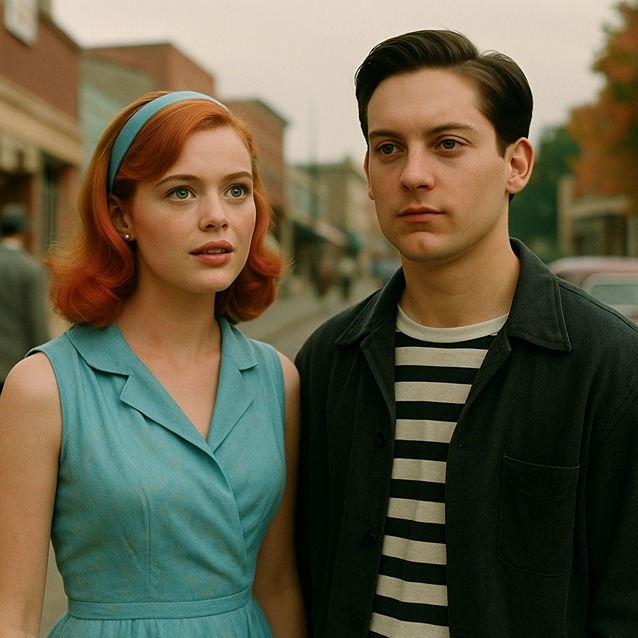
One of the earliest turning points in Pleasantville centers on Bud (played by Tobey Maguire) and his relationship to imperfection. At the beginning of the film, Bud escapes into the black-and-white world of a 1950s TV show because real life feels messy and uncertain. The fictional town of Pleasantville offers predictability—everyone’s polite, the basketball team never misses a shot, and nothing ever truly changes.
But as Bud and his sister bring real human complexity into that sterile world, everything begins to shift. By the end of the film, Bud is no longer running from imperfection. He’s coaching his fictional mother through it—encouraging her to accept the unknown, to let things unfold without needing a clean, tidy resolution.
There’s a scene where Bud’s mother has become romantically involved with the ice cream shop owner. She’s terrified of what comes next. She doesn’t know how to reconcile this new love with the old expectations of her scripted life. Bud doesn’t offer her a clear answer. Instead, he helps her accept not knowing. He helps her embrace imperfection as something not to be feared but to be lived.
As a musician, I see this lesson constantly. Music—especially improvised music—is never perfect. A live performance is a living, breathing thing. There are mistakes, unexpected turns, broken strings, missed cues, moments that don’t land the way we imagined. But over time, you realize that these so-called imperfections are often what make the performance real.
In fact, some of the most transcendent musical moments I’ve ever experienced came from mistakes—when someone missed a cue or a rhythm shifted unexpectedly, and the band responded in a way that was alive and spontaneous. That’s what makes jazz so thrilling: it’s not a scripted world where the basketball team never misses. It’s a world where a missed shot becomes a riff that inspires the whole band.
In the creative life, perfection is often a cage. Pleasantville shows us what happens when we walk out of that cage.
2. Enjoying Uncertainty
The second lesson follows naturally from the first. Embracing imperfection leads to something even more profound: learning to enjoy uncertainty.
When Bud’s mom decides to stop trying to control everything and simply live in the unknown, something powerful shifts in her. She realizes that uncertainty isn’t a threat—it’s freedom. Her life is no longer confined to the pre-scripted Pleasantville narrative. Suddenly, she can make choices. She can feel. She can be human.
As musicians, uncertainty is part of the fabric of what we do. On the creative side, every improvisation is an act of stepping into the unknown. When you take a solo, you don’t know what’s going to happen next—what your fingers will find, what rhythmic surprises the drummer might throw at you, how the audience will respond. But when you stop resisting that uncertainty and start enjoying it, your playing comes alive.
On the professional side, uncertainty is just as present. You don’t always know where the next gig will come from, how a new project will take shape, or what creative opportunities might appear around the corner. There’s no steady roadmap for a life in the arts. But there is a kind of freedom that comes from learning to trust the journey.
The most fulfilled artists I know aren’t the ones who try to control every variable. They’re the ones who lean into uncertainty with curiosity rather than fear. Just as Pleasantville’s black-and-white world explodes into color when people start making their own choices, our artistic lives become richer when we let go of the illusion of control.
3. Allowing Self-Expression
One of the most memorable arcs in Pleasantville belongs to the ice cream shop owner, who discovers painting. At first, his life is completely scripted—scooping ice cream the same way, saying the same lines, living inside someone else’s vision of what life should be. But when he begins to paint, everything changes.
There’s a line he says that stuck with me: “I can’t imagine not painting.”
For me, that line cuts straight to the core of what it means to be a musician. I can’t imagine not making music. There was a time early in my life when I went on job interviews for other careers, trying to be practical. But every time I walked out of those interviews, I’d think, I hope I don’t get this job. Because deep down, I knew I belonged to music.
When you find the thing that truly lights you up, it stops being optional. It becomes oxygen.
And here’s something I’ve learned over time: the best days are the ones when I honor that creative impulse first thing in the morning. For me, that means meditating and then practicing—before the emails, the to-do lists, the logistics of life. On those days, everything flows. On the days when I try to “take care of business” first, the music often gets squeezed in between tasks. It’s still there, but it doesn’t have the same radiant power.
Self-expression isn’t a luxury. It’s not something we fit into the cracks of our lives after we’ve handled everything else. It’s a source of vitality. It’s the thing that makes everything else work better.
Pleasantville reminds us of that. When the shop owner paints, his world expands. When we play music, ours does too.
4. Welcoming New Art and Resilience in the Face of Rejection
As more and more people in Pleasantville start to embrace new forms of self-expression, the old order pushes back. The shop owner’s art is met with outrage. Bricks are thrown through his window. His world is literally smashed.
And yet, he doesn’t crumble. He doesn’t retreat. He doesn’t apologize for creating something new. Instead, he and Bud respond with something even bolder—a huge mural on the police station wall.
This is one of my favorite moments in the film because it’s exactly what artists must do when faced with rejection: create more.
Every artist, musician, or creative entrepreneur faces external rejection at some point. A gig falls through. A project flops. An audience doesn’t get it. A critic tears you down. But what’s just as important—and often more subtle—is internal rejection. That little voice in your head that says: “That’s not real music.” “I don’t do that kind of art.” “That’s not me.”
In other words, we can be just as rigid as the fictional townsfolk of Pleasantville.
Part of being an artist in the modern world is staying open—to new genres, new cultures, new technologies, new ways of seeing and making. The world is changing faster than any of us can fully keep up with. But the moment we start to resist that change, we begin to limit ourselves.
I’ve had many experiences as a musician where exploring a style I didn’t initially like ended up expanding my entire creative palette. Sometimes, the genres that feel the farthest from our comfort zones hold the richest lessons. If I had clung to my own narrow sense of what “real music” is, I would have missed entire worlds of rhythm, harmony, and expression.
The shop owner in Pleasantville didn’t let rejection stop him. He didn’t let it define him. He made something bigger. That’s the posture of the resilient artist.
5. Feeling Emotion Deeply
Perhaps the most profound lesson of Pleasantville is also the simplest: feeling is what brings color to life.
Early in the film, Bud’s sister can’t understand why she hasn’t turned from black and white to color yet—even though she’s had what she assumes are all the right experiences. “I’ve had like ten times as much sex as anyone else,” she protests. But Bud gently suggests, “Maybe it’s not about that.”
Later, we see how people change: not through action alone, but through emotion. The shop owner turns to color when he falls in love with painting. The father turns to color when he feels real love—and pain—for his wife. Even the prosecutor turns to color when he finally allows himself to feel anger.
Bud’s sister finally transforms when she reads a book by D. H. Lawrence and is moved not by external experiences, but by an internal emotional awakening.
That message couldn’t be clearer: emotion is the catalyst of transformation.
This is as true in art as it is in life. Technical perfection is impressive, but it’s emotion that moves people. A perfectly executed solo might make listeners nod appreciatively, but a solo played with raw feeling can make them weep.
As artists, we sometimes learn to mute our emotions in the name of professionalism, polish, or efficiency. But our emotions are not liabilities. They’re our guidance system. They tell us whether we’re aligned with something real.
I often think of what Abraham Hicks teaches: emotions are a spiritual guidance system. They point us toward alignment—or away from it. If we’re playing music and we feel joy, flow, or inspiration, that’s a sign we’re in tune with something larger than ourselves. If we feel constriction or resentment, it may be time to realign.
In Pleasantville, the moment the characters allow themselves to feel, their world literally bursts into color. As musicians, when we allow ourselves to feel deeply, our playing bursts into life.
The Artist’s Journey as a Movement from Black and White to Color
One of the most striking visual devices in Pleasantville is its gradual transition from black and white to color. At first, everything is monochrome—safe, predictable, uniform. But as each character embraces imperfection, uncertainty, self-expression, new art, and emotion, they literally become alive in color.
That’s not just a clever filmmaking technique. It’s a perfect metaphor for the creative journey.
Many artists start their lives trying to play everything “right.” They study the rules. They try to avoid mistakes. They want approval. It’s a black-and-white world—orderly but lifeless.
Then something shifts. They hit a wrong note and instead of cringing, they lean into it. They take a risk and discover that uncertainty is actually thrilling. They fall in love with their craft. They create something that others reject but that feels true. They feel something real. And suddenly, their world explodes into color.
Color doesn’t mean perfection. It means life.
Practical Reflections for Musicians
It’s one thing to feel inspired by a film like Pleasantville and another to translate that inspiration into daily practice. Here are a few practical ways the film’s themes can inform the musician’s path:
1. Make friends with mistakes
Instead of judging yourself when something goes “wrong,” experiment with turning it into something new. In jazz, we say, “There are no wrong notes—just notes that need resolution.”
2. Build comfort with not knowing
Improvisation isn’t just about soloing—it’s about cultivating trust in the unknown. You don’t need to have the perfect plan for your career or your next gig. Focus on showing up and staying curious.
3. Protect your self-expression time
Prioritize your creative practice before the logistics of the day take over. Whether it’s composing, improvising, or practicing technique, treat your art like the sacred source it is.
4. Explore outside your genre
Once in a while, deliberately immerse yourself in a style of music you’ve previously ignored—or even disliked. See what happens when you approach it with curiosity instead of judgment.
5. Let emotion lead
When performing or composing, check in with how you feel. If the music isn’t moving you, it probably won’t move anyone else. Don’t be afraid to feel—joy, sorrow, frustration, elation. That’s what makes art real.
A Broader Creative Philosophy
Although I’ve focused on the musician’s journey here, these lessons apply to all artists—and frankly, to anyone trying to live a full human life.
-
Embracing imperfection frees us from impossible standards.
-
Enjoying uncertainty allows us to make real choices.
-
Self-expression connects us with our purpose.
-
Openness and resilience keep us growing.
-
Feeling deeply turns existence into color.
Pleasantville is a love letter to what happens when a society—or an individual—stops living by script and starts living creatively. As artists, that’s what we do every day. Whether it’s with a guitar, a paintbrush, a camera, or a pen, we step into a world of black and white and insist on painting in color.
Closing Thoughts: The Courage to Live in Color
At the end of Pleasantville, the characters face an uncertain future. The world they once knew is gone. There’s no script to follow anymore. And yet, they’re more alive than they’ve ever been.
That’s exactly what the creative path feels like. There’s no map. There’s no guarantee. There’s just the daily choice to keep creating, to keep feeling, to keep stepping into the unknown.
As a musician, I’ve learned that the best moments of my life have rarely come from following a clear script. They’ve come from the times when I allowed myself to be surprised—by a melody, by a collaboration, by an emotion. That’s where the magic lives.
And that’s what Pleasantville gets so right: the real world, with all its mess and imperfection and uncertainty, is infinitely more beautiful than the perfect but lifeless black-and-white version.
So here’s to embracing imperfection. Here’s to uncertainty. Here’s to self-expression, resilience, and emotion. Here’s to making music—and making life—in full, glorious color.
—
If you are planning a wedding, private party, or corporate event and you want to explore your options for musicians to provide live music, book a free music consultation with me or simply write to me on the contact page.
